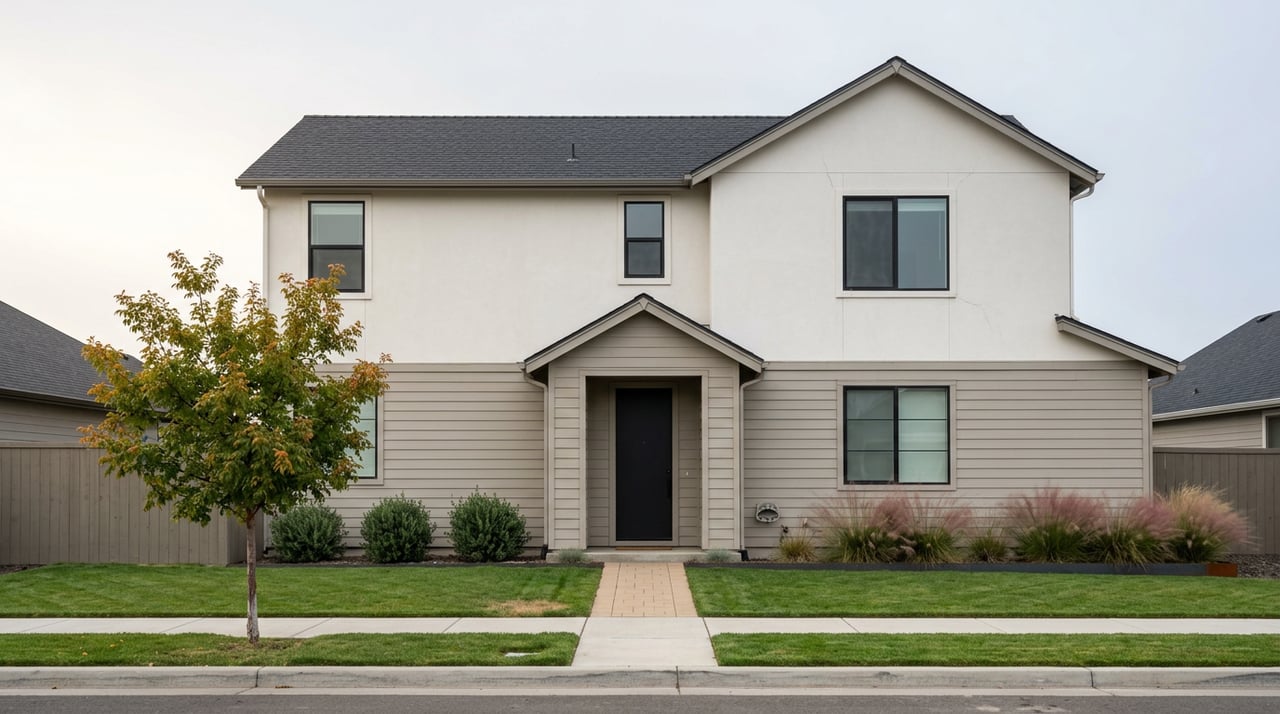
You're touring a new build in north Modesto. The agent points to a sign near the model home: "No HOA!" You breathe a little easier, because you've heard the horror stories about $300-a-month community dues eating into a mortgage budget. Then escrow sends over the preliminary title report, and there's a line item you don't recognize. A special tax. Attached to the parcel. Renewing every year for a very long time.
That's not a mistake, and it's not the builder hiding something illegal. It's Modesto's Community Facilities District system doing exactly what it was built to do. The confusion is understandable, because "No HOA" and "no recurring community cost" sound like the same promise. In several of Modesto's active new-construction neighborhoods, they aren't.
What "No HOA" Actually Means Here
D.R. Horton's listings for Eve at Founders Point and The Crossings both carry the same marketing line: "No HOA!" paired with a 10-year limited warranty on the home itself. Read at face value, it suggests these communities skip the private governance structure that older master-planned subdivisions use to fund shared amenities.
Eve at Founders Point sits inside a larger masterplan called Founders Point, developed by two local builders working together, Florsheim Homes and Fitzpatrick Homes. The City of Modesto has its own planning document for the area, the Founders Point East Specific Plan, which lays out how the neighborhood's parks, streets, and drainage get built and paid for. That's the part the "No HOA" sign doesn't mention. Someone still has to fund the walking paths, the picnic tables, and the sports fields the builder is advertising. In Modesto, that funding usually comes from a different mechanism entirely.
Somebody Still Has To Pay For The Park
The City of Modesto's Community Facilities Districts exist specifically to solve this problem. According to the city's own CFD program, these districts are created to provide a funding and reimbursement mechanism for public facilities and services for various Specific Plan areas, and are meant to ensure that new development doesn't become solely the responsibility of the General Fund.
That second part matters. Before Proposition 13 capped how much property tax revenue local governments could raise, cities paid for new infrastructure out of rising assessed values. After 1978, that funding path narrowed, and the Mello-Roos Community Facilities Act of 1982 gave cities a workaround: form a district, sell bonds against future tax revenue, and use the bond money to build the roads and parks up front. Homeowners in the district repay the bonds through an annual special tax that shows up on the property tax bill, separate from the standard 1% rate.
So when a listing in a specific-plan neighborhood says "No HOA," it's worth asking a follow-up question instead of taking the relief at face value: how is the park getting paid for, if not through an association? In Modesto's specific-plan areas, that answer is very often a CFD. The park still gets built. The bill still gets paid. It just arrives through a different door, one attached to the county tax collector instead of a homeowners association board, and it's a door worth checking before you assume "no HOA" means "no line item."
| HOA | CFD (Mello-Roos) | |
|---|---|---|
| Who sets the amount | Elected homeowner board | Fixed by district formation, adjusts per its own formula |
| Can you vote to lower it | Yes, through the board | No, the rate is set when the district forms |
| How long it lasts | Indefinite, tied to the association | Typically 25 to 40 years, tied to the bond term |
| Where you see it | Separate HOA bill | Line item on your property tax bill |
The Clock Started Before You Signed Anything
Here's the detail that catches new construction buyers off guard more than the tax itself: the bond term is fixed to the date the district was formed, not the date you bought the house. A CFD created in 2018 with a 30-year bond runs through roughly 2048 no matter who owns the parcel in between. Buy in year three of that district and you're carrying 27 years of payments. Buy in year twenty and you're carrying ten.
A few other mechanics worth knowing before you're mid-escrow on a Modesto new build. Some communities carry more than one CFD stacked on the same parcel, one for roads, another for parks or schools, so it's worth asking whether you're looking at a single assessment or several. California law requires the CFD status to be disclosed to buyers through the Natural Hazard Disclosure report, so it should never be a surprise at the closing table if you've read that document closely. Most districts allow prepayment of your remaining share of the bond, which some long-term owners choose specifically because it can make the home easier to sell later, since future buyers run the same math you're running now.
That resale angle is worth sitting with if you're the kind of buyer thinking five or ten years out. A property with fifteen years left on its CFD bond reads differently to a future buyer than one with three years left. The tax doesn't shrink with your home's value the way your base property tax roughly does. It stays fixed, or adjusts on its own schedule, regardless of what the market does to your equity.
The Incentive Sitting Right Next To The Tax Line
New construction shoppers in Modesto are also going to run into builder incentives, and it's easy to let a flashy incentive number distract from the CFD conversation entirely. Builders commonly offer temporary rate buydowns, where the interest rate is reduced for the first year or two before reverting to the full rate, or closing cost credits that lower your cash needed at the table. Kiplinger's breakdown of these programs notes that builders often treat the incentive as the main negotiation lever rather than the price itself, which can limit your flexibility if you'd rather see the number come off the purchase price instead.
None of that makes the incentive bad. It just means the incentive and the CFD line item need to be evaluated together, not separately. A $10,000 closing credit is a real number. A $2,400-a-year special tax with 28 years left is also a real number. Ask the builder's sales office for both, in writing, before you get attached to a specific lot.
What This Looks Like On A Modesto Payment Today
Modesto's median sold price sat at $445,000 across roughly 1,076 tracked closings over the six months ending in August 2026, with the middle half of sales closing between $365,000 and $530,000. That's a tight enough spread that a buyer comparing new construction against resale inventory can reasonably expect to find both within a similar price band.
The problem with a price-alone comparison is that it hides the CFD gap. Two homes near that $445,000 median, one in an established resale neighborhood without a district and one in a new subdivision with a $2,000-a-year CFD, carry meaningfully different true monthly costs once you divide that annual number by twelve and add it to your mortgage estimate. It's not a reason to avoid new construction. Plenty of buyers decide the newer streets, the warranty, and the amenities are worth the tradeoff. It's a reason to run the comparison with real numbers instead of sticker prices.
Before You Write The Offer
- Ask the builder or listing agent for the current annual CFD amount for the specific lot, not a community average.
- Confirm how many years remain on the bond, since that number is fixed to the district's formation date.
- Check whether the parcel sits inside more than one CFD.
- Request the Natural Hazard Disclosure report early and read the special tax section directly.
- Get any rate buydown or closing credit spelled out as a dollar figure in writing, separate from the CFD conversation.
Does the CFD go away if I pay off my mortgage early? No. The special tax is tied to the property and the bond term, not to your loan. Paying off your mortgage has no effect on it. Some districts do allow you to prepay your share of the bond directly, which is a separate transaction from your mortgage entirely.
Can I negotiate the CFD amount with the builder? Not directly. The rate was set when the district formed, before the builder ever listed the lot. What you can negotiate is everything else around it, including price, incentives, and upgrades, with the CFD number factored into your total cost math from the start.
Modesto's new-construction subdivisions have real advantages, from the warranties to the walking paths that a specific plan like Founders Point East was written to guarantee. The people buying into them just deserve to see the whole bill before they sign, not the half that fits on a yard sign. If you're comparing a new build against resale inventory and want the CFD, incentive, and total payment numbers laid out side by side for a specific address, Jose Diaz can walk through it with you in English or Spanish. Schedule a consultation before you write the offer, not after.


